× The School of Athens The artist Raffaello Sanzio (1483–1520), known as Raphael, was born in Urbino, the son of Giovanni Santi, a painter and poet at the ducal court. Orphaned young, he trained in the circle of Perugino and by his early twenties was working in Florence, absorbing the lessons of Leonardo da Vinci and Michelangelo. He went on to become, with them, one of the three great masters of the High Renaissance, celebrated for the clarity, grace and harmony of his compositions.
His career was brilliant and brief. In Rome he painted for two popes, ran one of the largest workshops of his age and, after Bramante’s death, became chief architect of the new St Peter’s. He died in 1520, aged just thirty-seven, and was buried, at his own request, in the Pantheon.
Why he painted it In 1508 Pope Julius II, unwilling to live in the rooms decorated for his predecessor and rival, Alexander VI, chose a new suite of apartments in the Vatican and summoned a group of painters to decorate them. Among them was Raphael, then about twenty-five and little known in Rome. He was given the room now called the Stanza della Segnatura, which most likely served as the pope’s private library. Across the corridor, Michelangelo was at work on the ceiling of the Sistine Chapel.
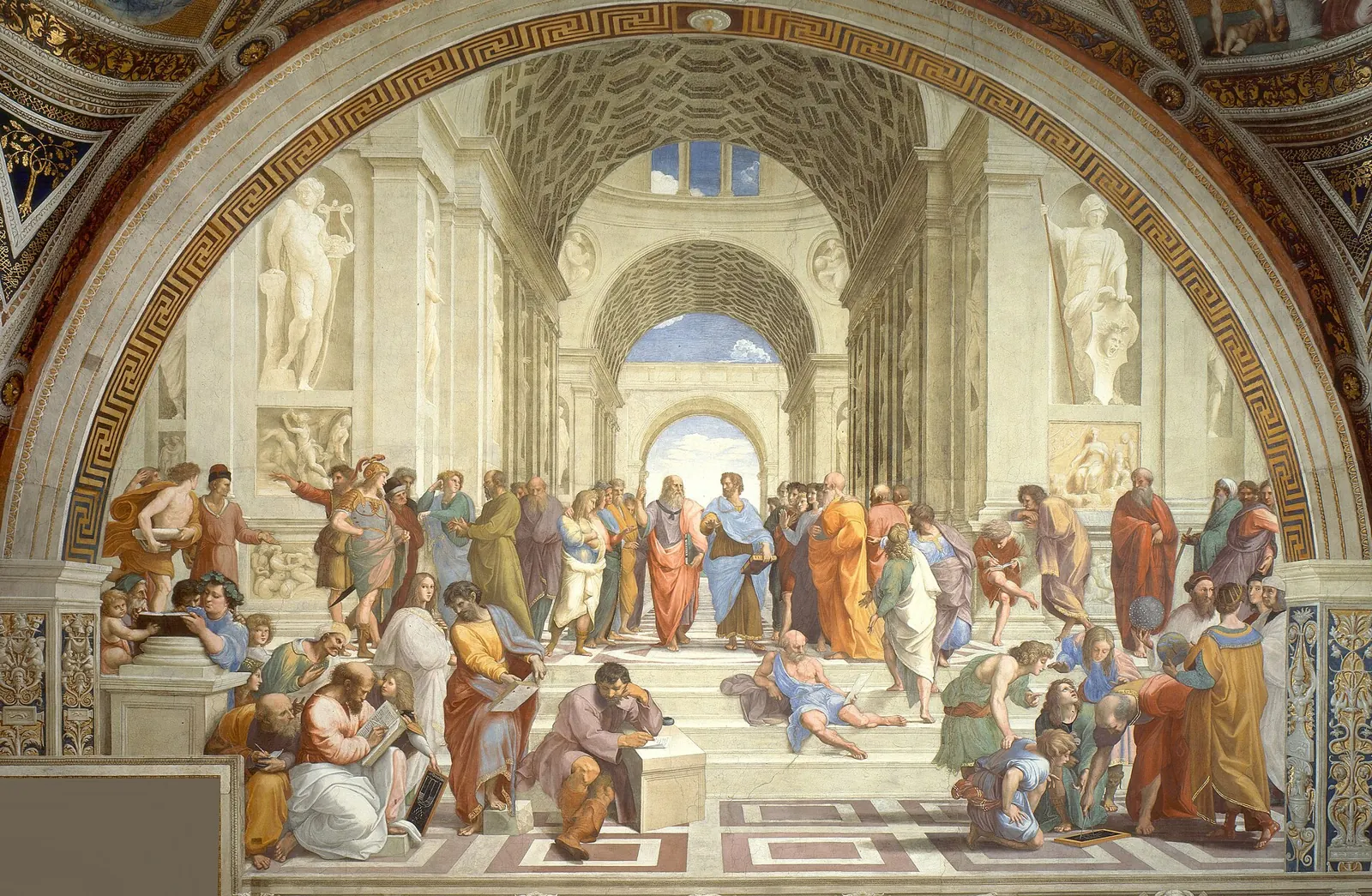
The room’s four walls follow the four branches of a Renaissance library: theology, philosophy, poetry and law. The School of Athens, painted between about 1509 and 1511, is philosophy’s wall, facing a fresco of the Church’s theologians across the room, so that human reason and divine revelation answer each other. Julius was so impressed that he dismissed the other painters, had some of their work painted over and gave Raphael the remaining rooms. The painting’s famous title is not Raphael’s own: it was given long after his death.
What it depicts Around five metres high and almost eight metres wide, the fresco gathers more than fifty figures beneath a vast vaulted hall, inspired by Bramante’s designs for St Peter’s and watched over by statues of Apollo and Athena. At the centre walk Plato and Aristotle: Plato holds his Timaeus and points upwards to the world of ideas, while Aristotle holds his Ethics and stretches his hand over the earth. Around them, thinkers from different centuries debate, read, calculate and teach. Socrates counts off his arguments on his fingers, Pythagoras writes in a book, Diogenes sprawls on the steps, and Euclid bends over a slate with his compasses, while Ptolemy and Zoroaster hold globes of the earth and the heavens.
Raphael gave several of them the faces of his own contemporaries: Plato is often said to resemble Leonardo, Euclid bears Bramante’s features, and the brooding Heraclitus, absent from the preparatory drawing, has the likeness of Michelangelo, added after Raphael saw the first half of the Sistine ceiling. At the far right, Raphael painted himself among the crowd, looking out at us.
In spirit, the fresco is a cousin of Sadequain’s Treasures of Time on this site’s Writing page : both gather thinkers from different centuries into one imagined assembly, and both artists painted themselves into the crowd.
The full-size preparatory drawing, or cartoon, survives in the Pinacoteca Ambrosiana in Milan, one of the largest Renaissance drawings in existence. The fresco itself remains where Raphael painted it, now part of the Vatican Museums and seen by millions of visitors each year.
Understanding the numbers Raphael left no key to his figures. The names come from tradition, beginning with Giorgio Vasari’s description of the fresco in 1550, and from centuries of later scholarship, which often disagree. Only a handful of identifications are secure.
21 figures are numbered here: 9 blue and 12 amber .
Blue: a widely accepted identification. These are the figures identified with the greatest confidence; the colour does not imply absolute historical certainty.
Amber: a proposed or disputed identification. A name or alternatives have been suggested, but the identity is not securely established; each description explains the uncertainty.
No number: no secure identification. Those figures remain unnamed here rather than being given a speculative identity.
The numbers are this page’s navigation guide, not part of the fresco. Select any number to read more.
Image in the public domain. More at the Vatican Museums ↗